By Iftikhar Gilani | Frontline | June 1, 2026
Amid Myanmar’s prolonged civil war, the scholar and activist argues that New Delhi’s strategic concerns over border security and connectivity have outweighed democratic considerations.
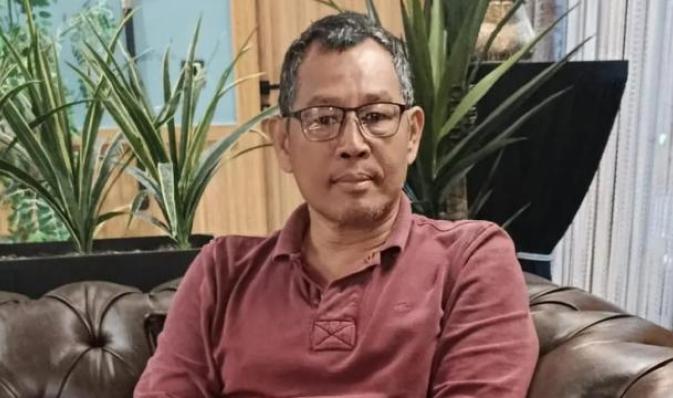
Maung Zarni is a Myanmar-born scholar, human rights activist, and one of the world’s most prominent advocates for Rohingya rights. Based in the United Kingdom, he has spent decades documenting atrocities committed by Myanmar’s military and campaigning for international accountability. He was among the earliest voices to characterise the military’s actions against the Rohingya as genocide. He played an important role in supporting international efforts that eventually led to the case against Myanmar before the International Court of Justice (ICJ) for genocide.
His assessment comes at a time when India is engaging Myanmar’s military leadership despite the country’s deepening civil war and growing international isolation. For New Delhi, Myanmar remains central to its strategic calculations involving China’s influence, the security of India’s northeastern States, border stability, and key connectivity projects such as the Kaladan Multimodal Transit Transport Project. Yet the realities on the ground have changed dramatically. Large parts of Myanmar are no longer under the control of the military, while ethnic armed organisations now dominate vast territories across the country.
In this interview, Zarni discusses India’s Myanmar policy, China’s expanding influence, the implications for India’s northeastern States, the rise of the Arakan Army, the future of the Rohingya crisis, and the prospects for a country he says increasingly resembles the fragmented landscape of the former Yugoslavia. Edited excerpts:
India is engaging Myanmar’s military leadership despite widespread international criticism. Military ruler Min Aung Hlaing visits India. What explains New Delhi’s approach?
The relationship is centred primarily on strategic and military considerations rather than economic ones. Myanmar is not particularly significant to India economically, but it is very important geopolitically.
India has two major concerns. First, it wants secure connectivity to its northeastern States through projects such as the Kaladan corridor. Second, it does not want Myanmar to become completely dominated by China. These considerations drive India’s engagement with the military authorities. For New Delhi, maintaining relations with the military is seen as the most practical way to protect its interests, regardless of the political situation inside Myanmar.
How important is Myanmar to northeastern India?
It is extremely important. Myanmar is not simply a neighbouring country for India. It is directly connected to the future stability and economic development of the northeastern States. The logic behind projects such as the Kaladan corridor has always been that economic integration can promote stability. Better connectivity creates opportunities, reduces isolation, and, in theory, reduces the incentives for armed conflict. At the same time, developments inside Myanmar inevitably affect States such as Manipur and Mizoram because communities living on both sides of the border share ethnic, cultural, and historical ties.
Does the conflict in Myanmar have implications for the unrest and security challenges in northeastern India?
Absolutely. Many ethnic communities straddle the border. The Chin population in Myanmar, for example, has close connections with communities in northeastern India. What complicates matters for India is that many border areas are no longer controlled by the Myanmar military. Agreements reached with Naypyidaw do not necessarily translate into control on the ground. This creates new challenges for border management and security cooperation.
The Kaladan Multimodal Transit Transport Project has been under discussion for more than two decades. Why has it struggled to move forward?
The project passes through areas that are now jointly controlled by the Chin Brotherhood and the Arakan Army. India negotiated the project with the Myanmar state, but those who exercise authority in the area today are different actors. This creates a difficult situation. If India wants the project to succeed, it may eventually have to engage with the groups that actually control the territory.
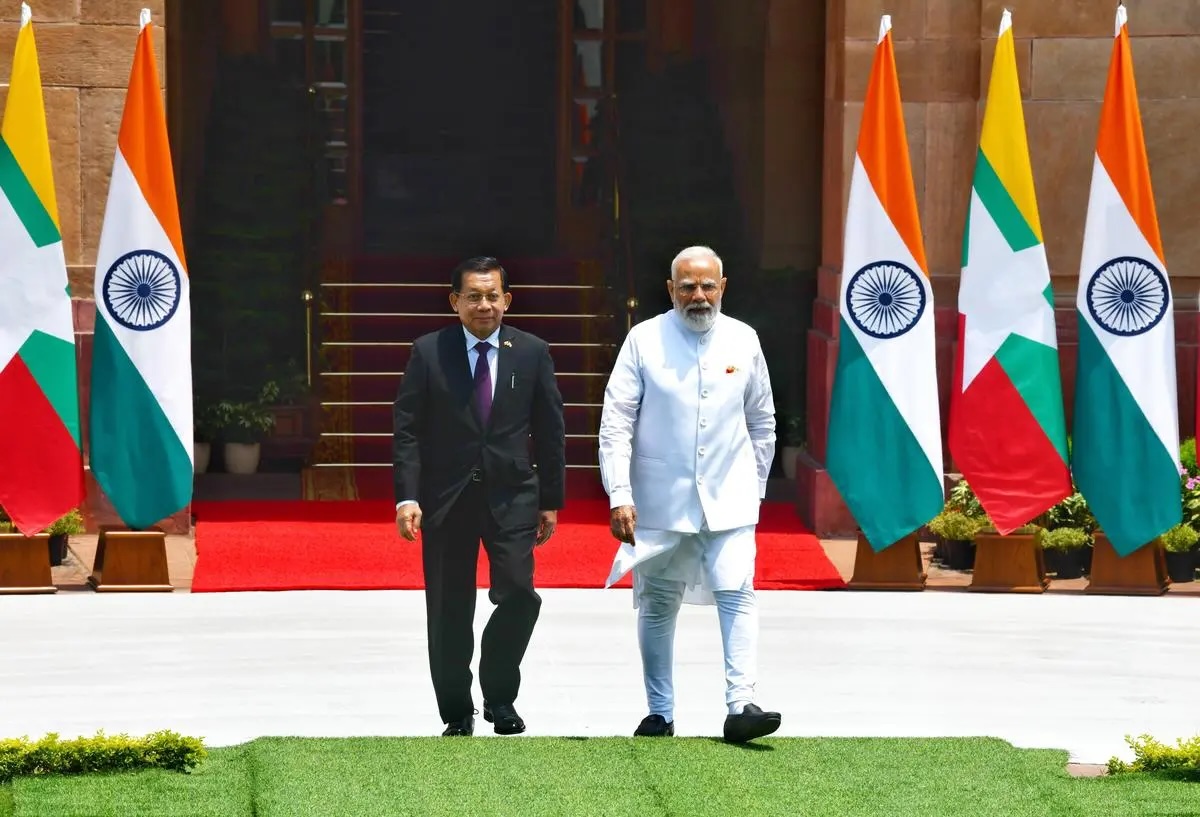 Prime Minister Narendra Modi meets the President of Myanmar, Min Aung Hlaing, at Hyderabad House, in New Delhi on June 1, 2026. | Photo Credit: ANI
How do you assess China’s influence in Myanmar today?
China’s influence is enormous and significantly greater than India’s. China has substantial economic and strategic interests in Myanmar, including oil and gas pipelines running from the Bay of Bengal to Yunnan province. These pipelines are strategically important because they provide China with alternative energy routes that bypass vulnerable maritime chokepoints. Initially, China maintained relations with multiple actors. But eventually, Beijing concluded that prolonged instability was not in its interests. It decided to support the military authorities more openly and pressured armed groups under its influence to reduce support for anti-junta forces.
You have said India is playing a losing game against China in Myanmar. Why?
Because China possesses deeper leverage and more effective instruments of influence. India cannot compete with China in terms of resources, strategic reach, or diplomatic influence inside Myanmar. Beijing has relationships not only with the military but also with armed groups operating in different parts of the country. China is able to shape events in ways India simply cannot.
What is the overall situation inside Myanmar today?
The primary conflict remains between the Myanmar military and the rest of the country. On one side is the military establishment. On the other hand are ethnic armed organisations, resistance forces, and pro-democracy groups. But there are also multiple local conflicts layered on top of the broader national conflict. Myanmar can no longer be understood as a single political conflict. It is a collection of overlapping wars involving different actors pursuing different objectives.
Militant groups now control large parts of the country. How fragmented has Myanmar become?
In terms of territory, ethnic armed organisations probably control more land than the military. However, the military still controls most major cities, commercial centres, airports, and diplomatic hubs. Myanmar today resembles the Balkans after the breakup of Yugoslavia. In some respects, it also resembles parts of Syria after state collapse. The country is deeply fragmented and divided among competing centres of power.
Yet Myanmar has not broken apart despite this fragmentation. Why?
The major difference between Myanmar and places such as the former Yugoslavia or Syria is that Myanmar’s neighbours have no interest in changing its borders. India, China, Bangladesh, Thailand, and Laos do not seek territory from Myanmar. None of them wants to create a precedent for redrawing borders because they all face their own internal challenges. That is one reason Myanmar remains fragmented but has not disintegrated. The country’s external borders remain stable even though authority inside those borders is increasingly contested.
What is happening in Rakhine state?
Rakhine state has become one of the most complex theatres of conflict in Myanmar. Historically, there have been three principal actors: the Myanmar military, the Arakan Army, and the Rohingya population. The military at one stage attempted to recruit and arm Rohingya groups against the Arakan Army as it began losing territory.
The situation became even more complicated because elements associated with different armed groups became involved in illicit activities such as narcotics trafficking and human smuggling.
Does the Arakan Army now control most of Rakhine State?
Yes. The Arakan Army controls most of the state, with the exception of a few strategic locations that remain under military control. These include the state capital Sittwe, areas linked to China’s oil and gas infrastructure, and several important military installations. The military increasingly controls isolated enclaves rather than large continuous territories.
What does this mean for the Rohingya crisis?
It makes the situation far more complicated. The Myanmar military says it is prepared to take Rohingya refugees back. But most of the areas to which they would return are no longer controlled by the military. They are controlled by the Arakan Army.
Bangladesh, therefore, faces a dilemma. It hosts roughly one million Rohingya refugees but is reluctant to engage formally with the Arakan Army because doing so could damage its relations with Myanmar. The result is a political stalemate. The actor offering repatriation does not control the territory, while the actor controlling the territory is not recognised as a legitimate negotiating partner.
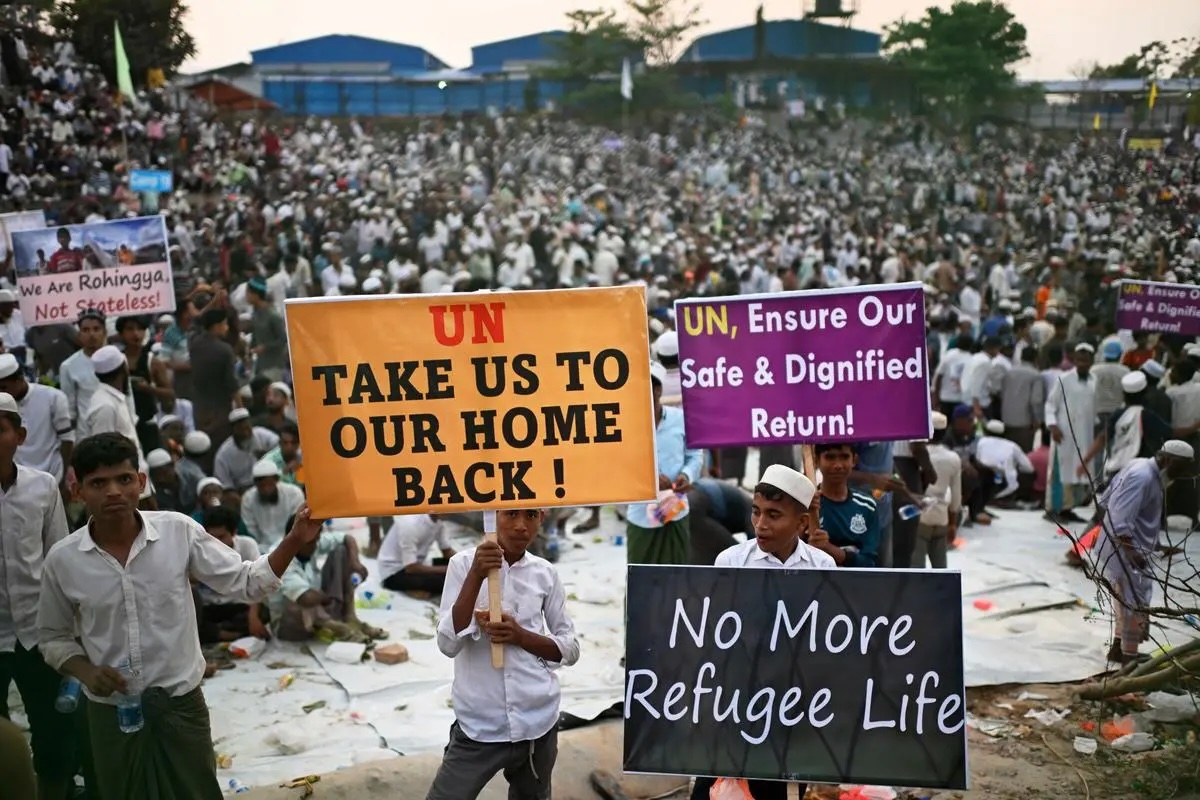
Rohingya refugee children carry banners during a visit by U.N. Secretary-General António Guterres at the Ukhiya camp in Cox's Bazar, in Bangladesh, March 14, 2025. | Photo Credit: AP
What is the status of the genocide case against Myanmar before the ICJ?
The evidentiary phase has largely been completed. The judges are reviewing the evidence and deliberating. A ruling may come relatively soon. However, the ICJ has no enforcement mechanism. It can issue judgments, but it cannot compel governments to comply. Nevertheless, its decisions remain important politically, legally, and historically.
What are the prospects for democracy in Myanmar?
There is no realistic pathway at present. Democracy cannot emerge from a prolonged military conflict. Neither the military nor many of the armed resistance organisations are particularly democratic in their internal orientation. Long wars tend to produce militarised thinking. For that reason, I do not see a clear path toward democratic restoration in the foreseeable future.
What role should regional countries play in stabilising Myanmar?
The problem is that the region itself is deeply divided. ASEAN is fragmented, and several member states are dealing with their own domestic political challenges. Even if ASEAN wanted to play a more active role, it would find it difficult to do so in ways that contradict China’s position. For the foreseeable future, Myanmar remains trapped in a political, humanitarian, and strategic quagmire with no obvious solution in sight.
Iftikhar Gilani is an Indian journalist based in Ankara.